Cultural Association Fons Josep Torrent Buch
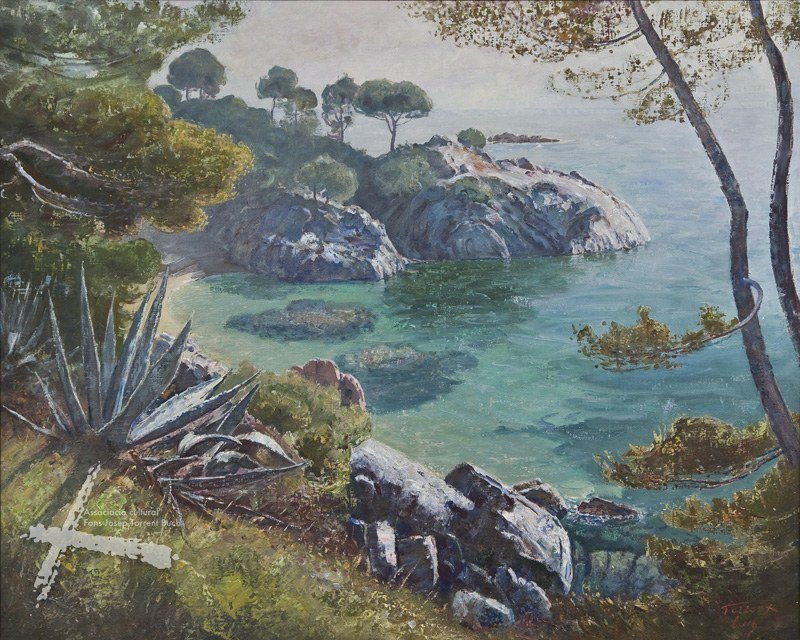
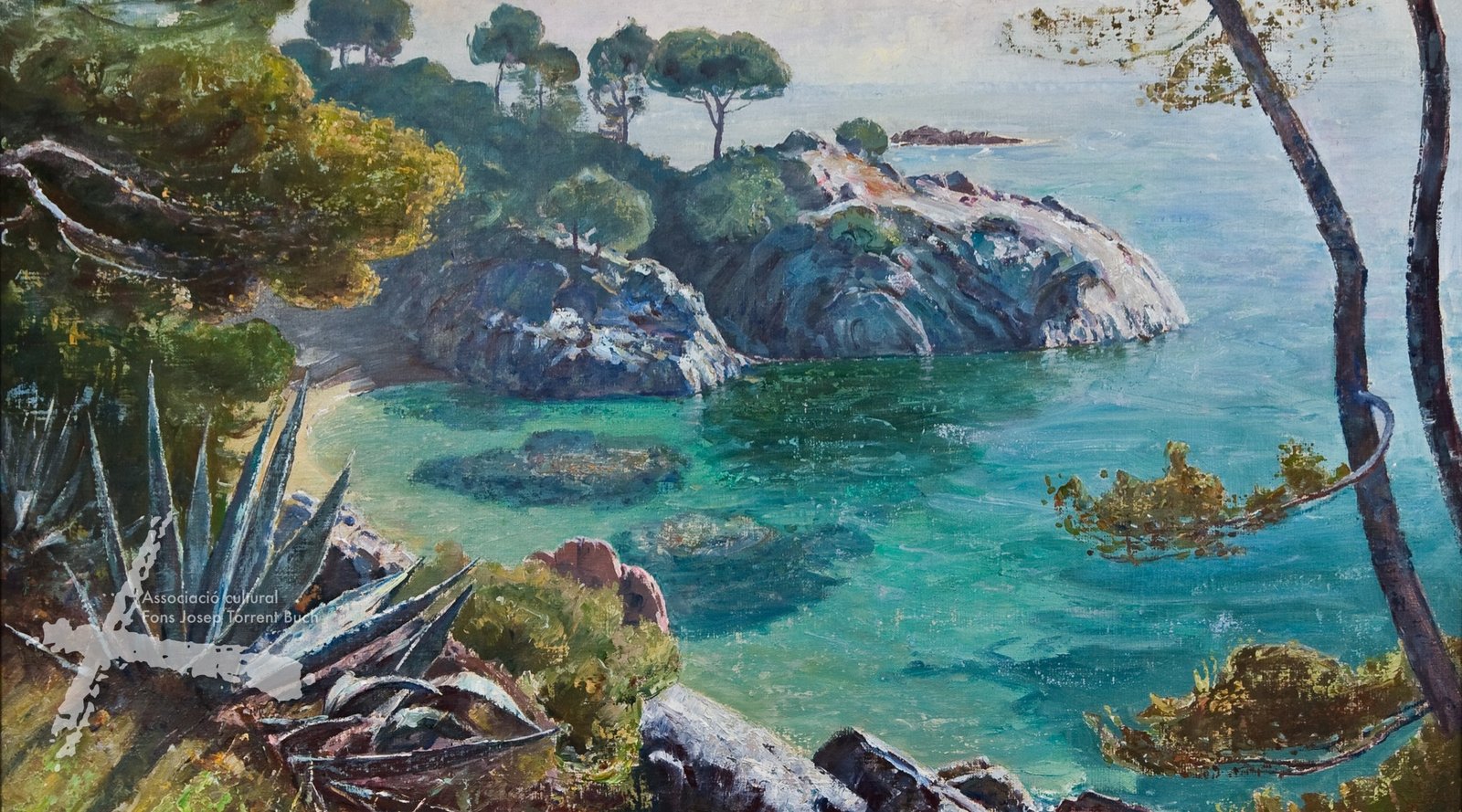
Painting by Josep Torrent Buch of a cove on the Costa Brava: turquoise water, rocks, pines and agaves in the foreground

Sant Feliu de Guíxols · 1915 — 1999

Josep Torrent Buch, the Painter of the Costa Brava

The Cultural Association Fons Josep Torrent Buch preserves, catalogues and promotes the work of an artist who devoted more than sixty years to painting the light, the transparencies and the movement of the sea.

“Painting, for me, has been the soul of everything”

+250
Exhibitions
+5,000
Works created
+60
Years painting
+800
Records in the Fons catalogue

Welcome

A space to keep the work of Torrent Buch alive

The Associació Fons Josep Torrent Buch welcomes you to its website, the showcase of what the Association represents and aspires to be. From here you can access the artist's biography, the press coverage of the period, the visit to the virtual exhibition held at the Castell de Benedormiens in Castell d'Aro and the programme of new exhibitions.

This space also aims to bring you the virtual catalogue of the Fons: a task that takes time and effort, but one that we will have achieved in the near future. Welcome, and enjoy the world of Torrent Buch.

Carles Torrent Vilà

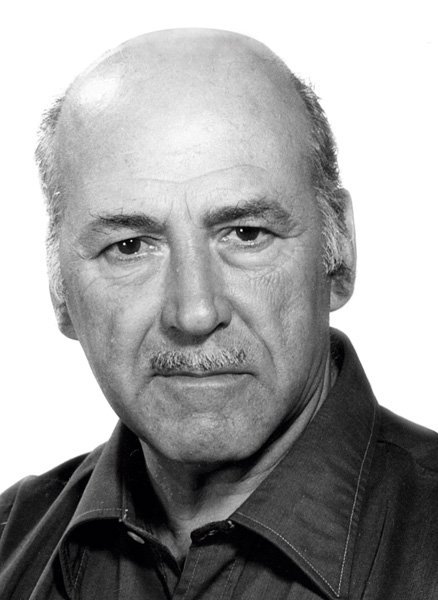
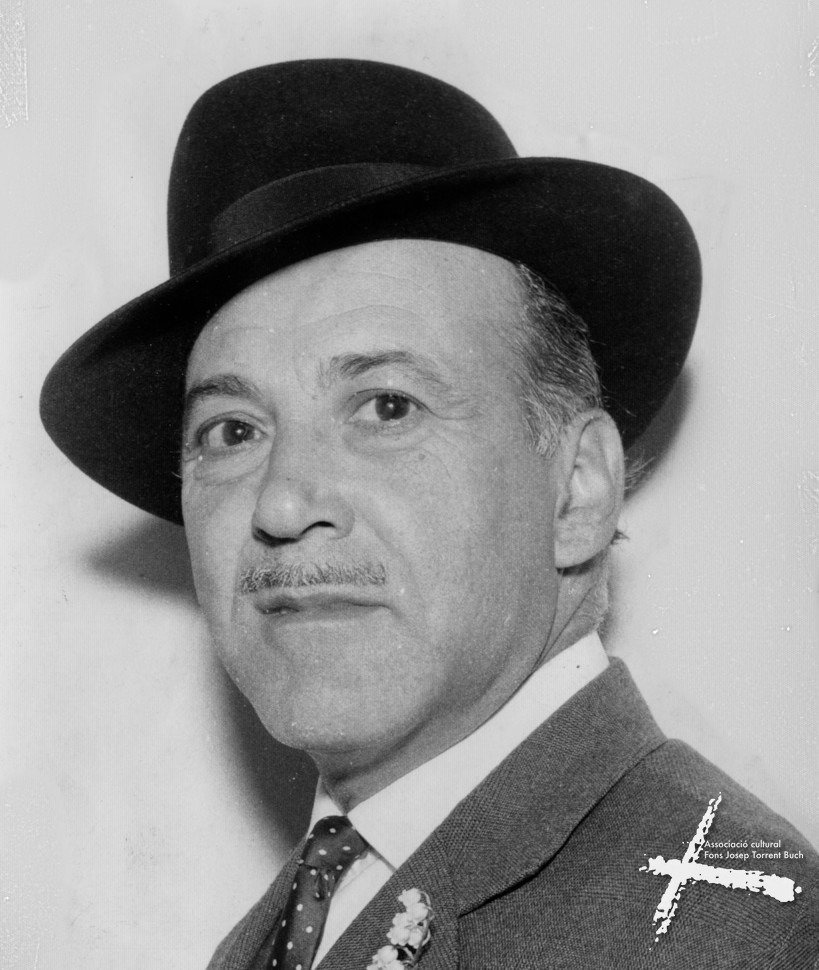
Black-and-white photographic portrait of Josep Torrent Buch wearing a hat, with a moustache and a jacket
Josep Torrent Buch (Sant Feliu de Guíxols, 1915–1999)

Objectives

  • That the work of Josep Torrent Buch, now scattered all over the world, be referenced and catalogued, with agreements with the institutions to obtain the necessary support.
  • To collaborate on the cultural projects that may be carried out in this field, whether or not they are directly related to art.
  • A non-profit association, with the intention of becoming an association of cultural interest.

What we do

  • We publish books and create initiatives in cultural fields.
  • We accept public and private donations and promote cultural events that provide the Association with the income it needs to operate properly.
  • In the field of new technologies, this website will host the complete catalogue of the Fons.

“Culture, the first step!”

Biography

A whole life devoted to painting

The life of Josep Torrent Buch, in four periods: from his beginnings in Sant Feliu de Guíxols to his consolidation as Painter of the Costa Brava.

1915–1936

The beginnings

Josep Torrent Buch was born in Sant Feliu de Guíxols on 18 January 1915. His interest in art and painting began very early, at the age of seven, his talent already evident in the first drawings he made between the ages of seven and ten.

During his first years at school, at the La Salle “Los Hermanos” school in his home town, he attended drawing classes every Thursday, preferring this activity, in the artist’s own words, to going out to play with his friends. It was then that he became aware of his interest in drawing and began classes at the local School of Fine Arts, run by Gertrudis Romaguera.

His progress and innate talent in his early youth took him in 1933, at the age of eighteen, to the Escola Superior de Disseny i Art Llotja in Barcelona, where he continued his studies in drawing and painting until 1936, and where he won three first prizes in drawing. To pay for his studies he worked as a house painter and devoted his free time to his art, going to the zoo and the aquarium to draw from life.

He took part in a group exhibition in Palafrugell, which would be his first official exhibition, from 12 to 22 July 1936. But the Spanish Civil War broke out on 18 July that year, and the exhibition had to end early.
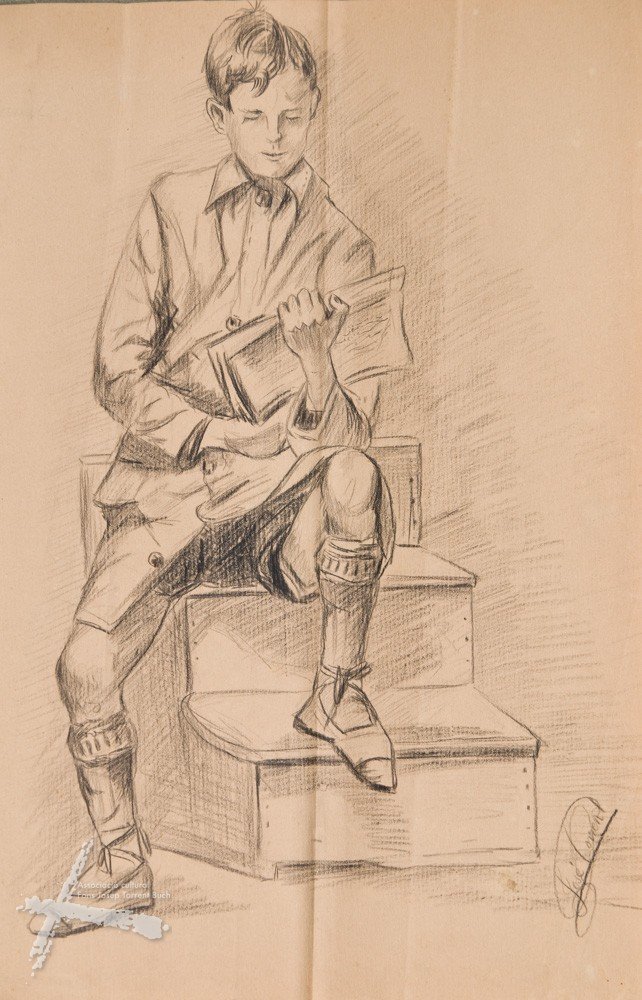
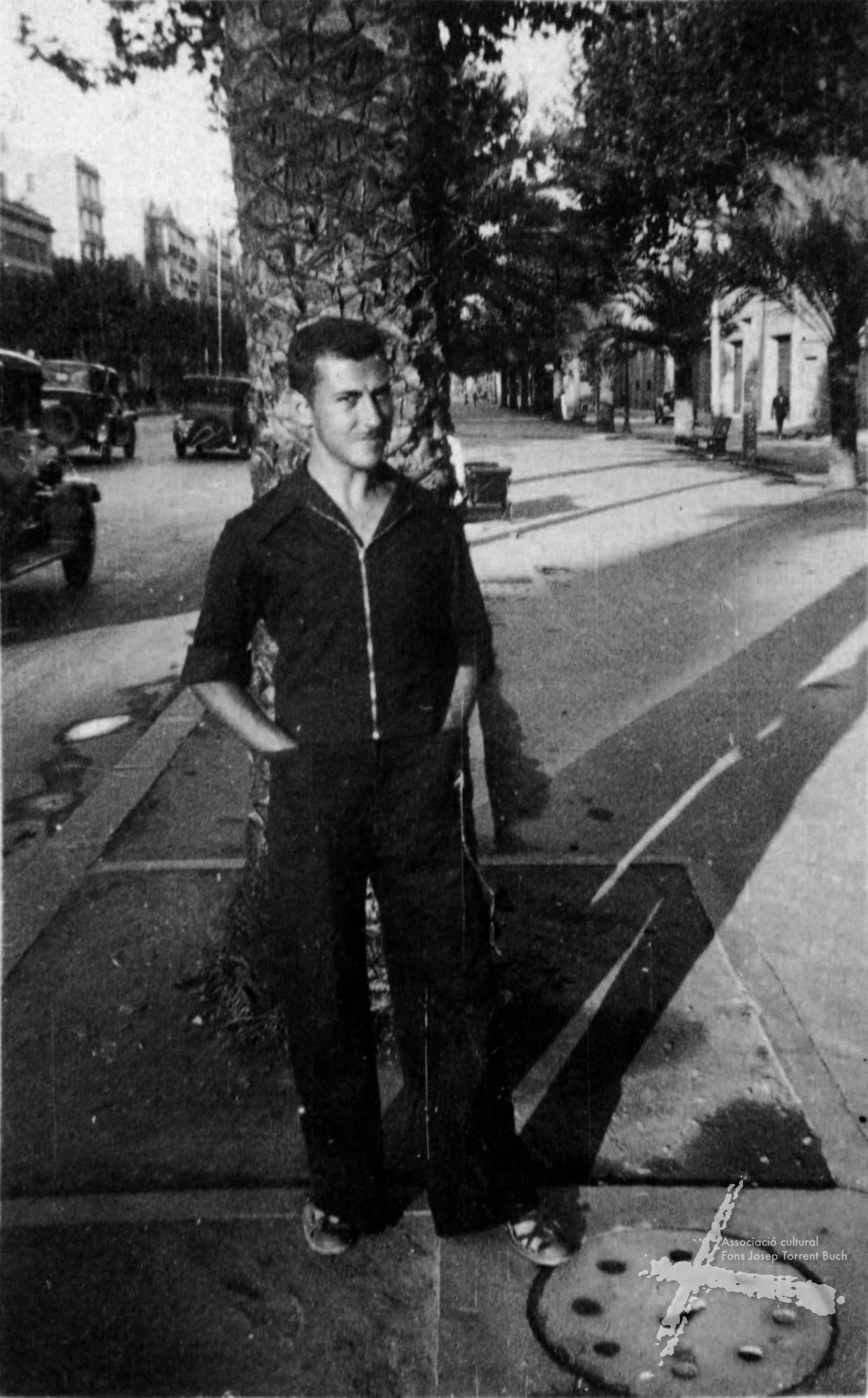
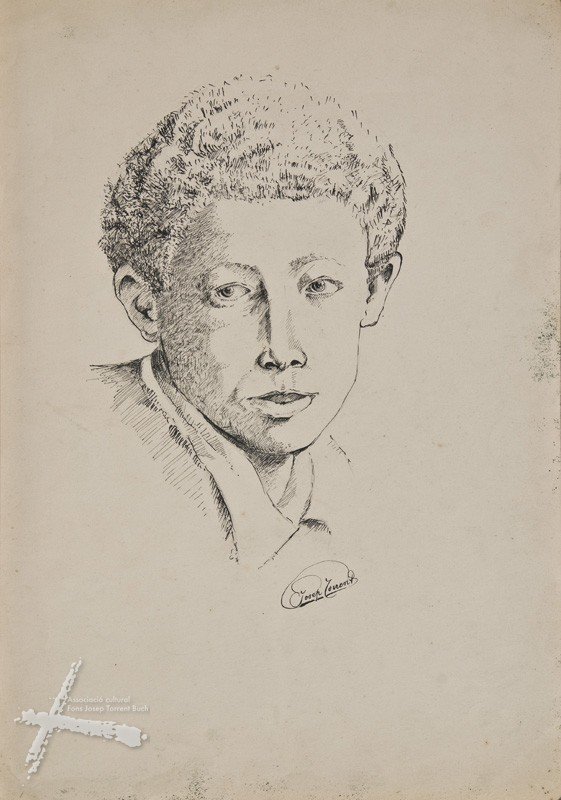
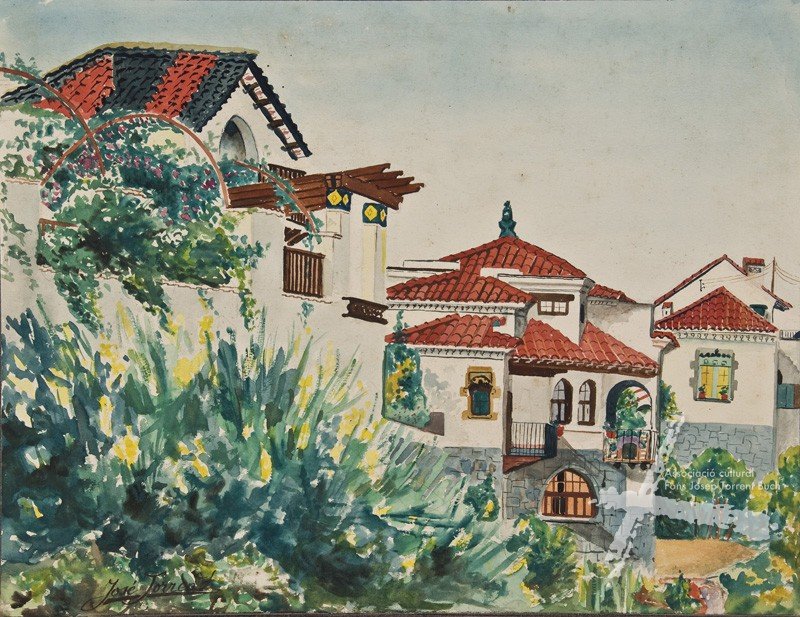
Drawing of a boy reading, sitting on some steps Black-and-white photograph of a young man in the street, with period cars and a palm tree Ink drawing of a young man's head, signed “Josep Torrent” Watercolour of houses with red roofs among vegetation
1936–1942

Times of War and Africa

At the end of 1936 he left for the war, to the Aragon front. He survived on several occasions thanks to his boldness and agility, but also thanks to his drawings, which he exchanged for food in farmhouses, for himself and his companions.

Thanks to his studies in perspective, he joined the Cartography Service of his regiment.

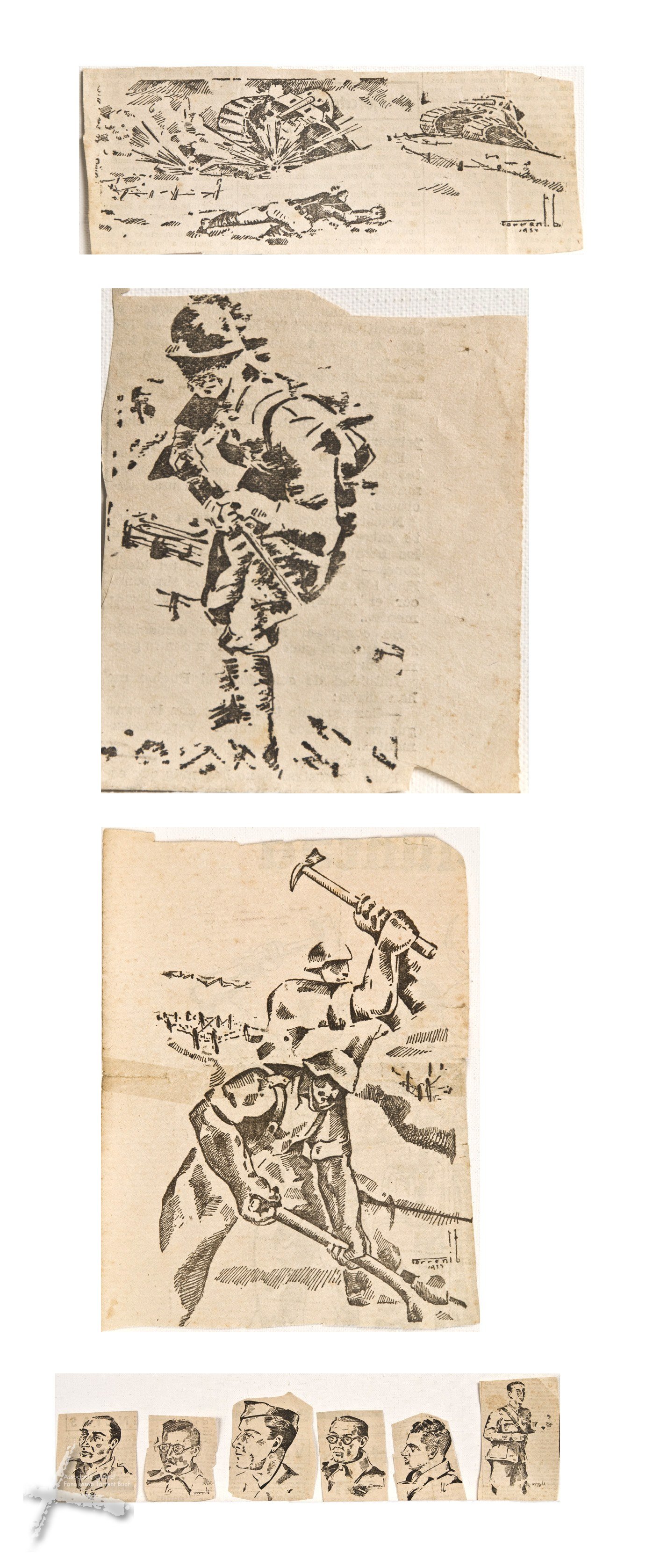
At just twenty-two years of age, and thanks to his artistic talent, he became the chronicler of the time, drawing war scenes from the front that were published in the press.

Later, in Barcelona, he took part in an exhibition of propaganda posters of the period, at the Plaça Catalunya metro station, in collaboration with Martí Bas and Clavé, who would go on to become a renowned poster artist.

At the end of 1938 he fled to France with his regiment, and he was made a war refugee at the Agde Hérault concentration camp, near Perpignan, where he spent about four months. It was there that he began to win over the officers, making portraits of them with which he obtained a certain degree of preferential treatment.

On his return to Spain he was detained for ten days in Figueres, where he was lodged at the home of Salvador Dalí’s sister. Once again his art made it possible for him to free himself from this detention, in this case thanks to a drawing in which the coat of arms of Spain appeared with the face of General Franco in transparency.

He arrived in Sant Feliu de Guíxols at the end of 1939. He held his first exhibition of drawings and paintings, on war themes, in premises on Carrer Major. This same exhibition, expanded, was held again in 1940, for the Epiphany festivities, in the same premises. At this time he also took part in the making of religious altarpieces, under the direction of Sebastià Platja.

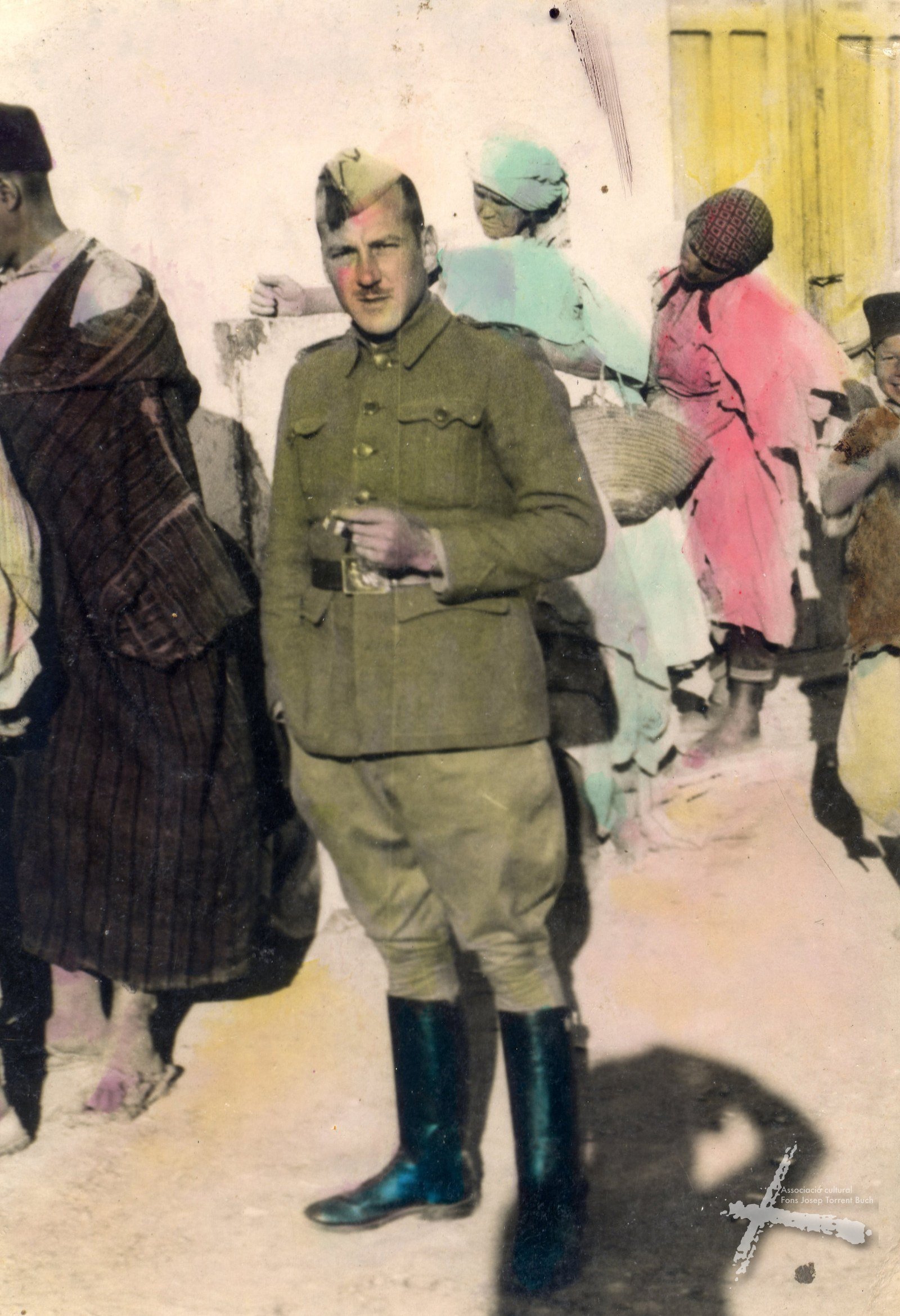
Throughout 1940 and into early 1941 he held a series of exhibitions, until he had to leave for compulsory military service, in Villa Sanjurjo, in Morocco, where he made a series of drawings on Arab themes that were exhibited right there.

In 1942 he returned to Sant Feliu, and it was then that he began to paint the coastal landscapes around the town: Cala del Vigatà, Cala de l’Ametller, Sant Pol, and different spots along the Costa Brava, from Sant Feliu to Tossa. It is here that we see the first transparencies that defined a style of his own and for which he received notable and well-deserved recognition.

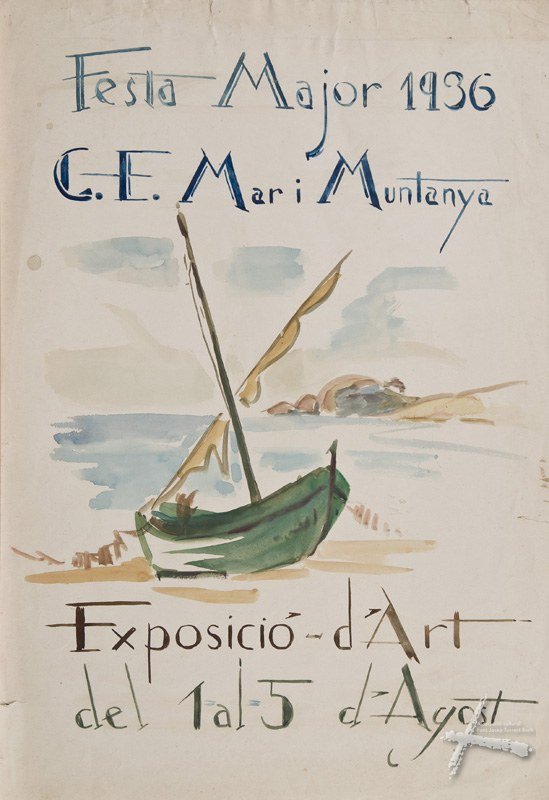
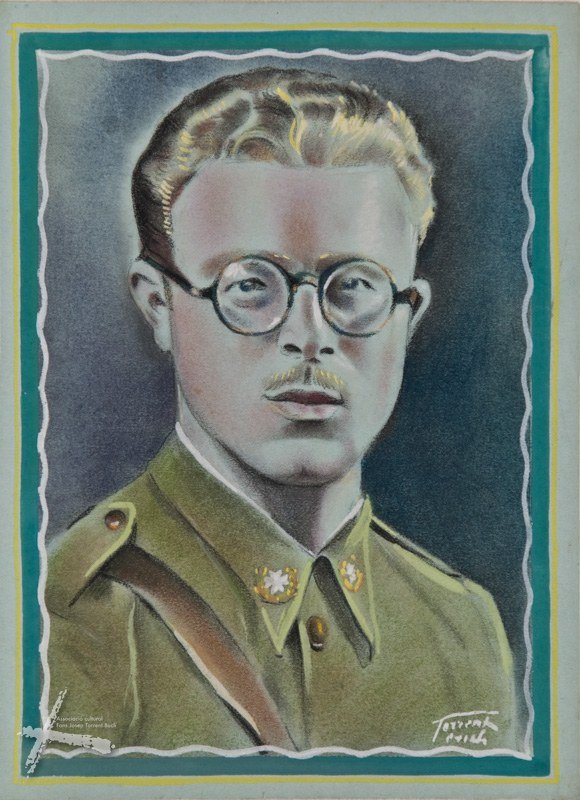
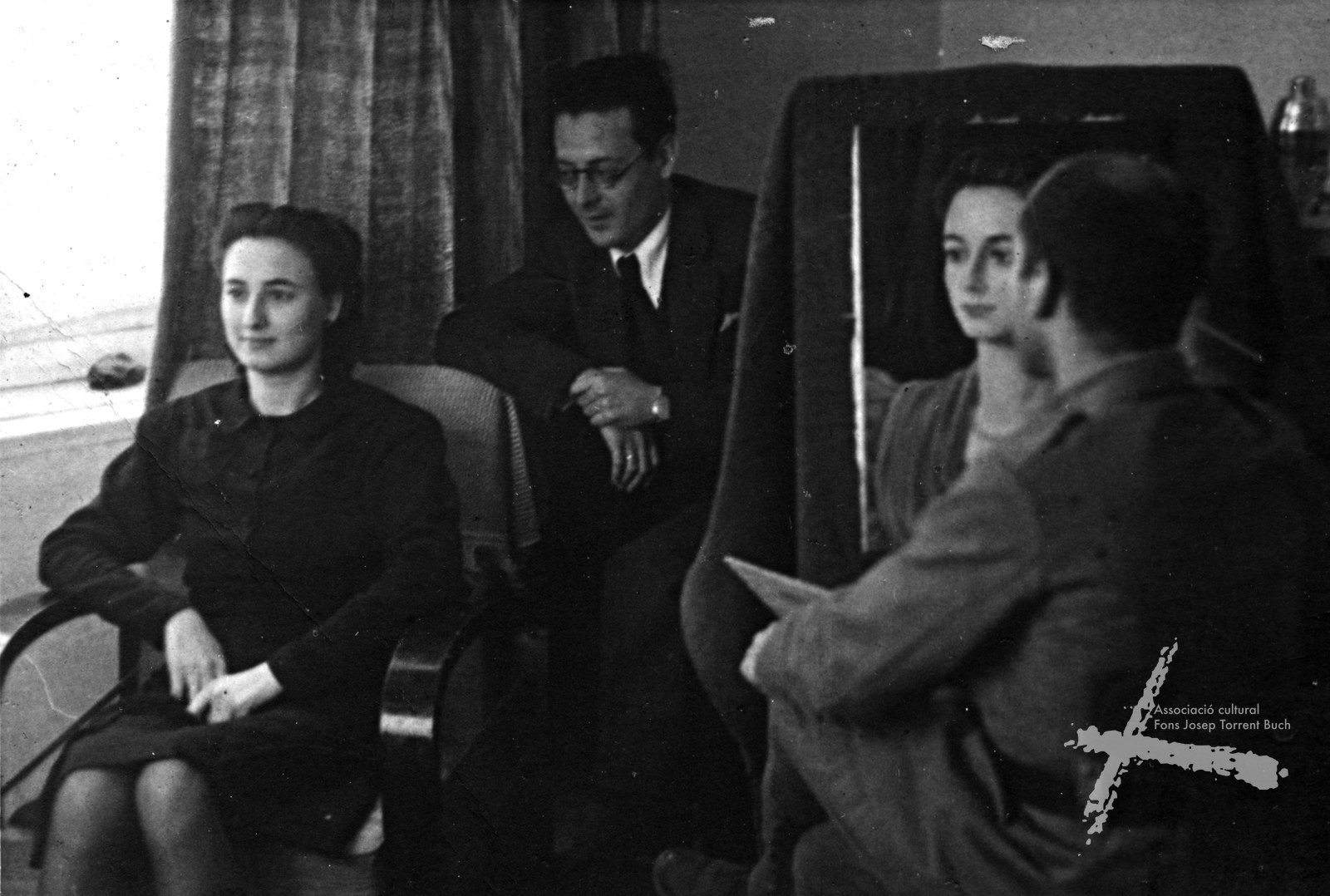
Composition of war drawings by Torrent Buch: a tank, a soldier, workers with picks and portraits of soldiers, signed in 1939 and 1941 Poster for the 1936 Festa Major of the C.E. Mar i Muntanya for the Art Exhibition from 1 to 5 August, with a green sailing boat Colour portrait of the young Torrent Buch in military uniform and glasses, signed in 1941 Black-and-white photograph of Torrent Buch painting the portrait of a woman, with two people posing Colourised photograph of Torrent Buch in military uniform in Morocco, among local people
1942–1960

The beginning of artistic recognition

From that moment his professional career as a painter began, and by 1950, according to specialist critics, it had made him the “Painter of the Costa Brava”. Seascapes clearly predominate in his work, with their transparencies, light and movement, and his work is a faithful testimony to the evolution of the landscape, in which the different eras can be seen, both physical and pictorial, brought about by the great tourist “boom” that took place on the Costa Brava in the years 1950–1970. During this period he exhibited in Barcelona, Girona, Madrid and other cities in the country; the written and radio press and the critics of the time mentioned him as an “emerging” artist, and he obtained very good reviews.

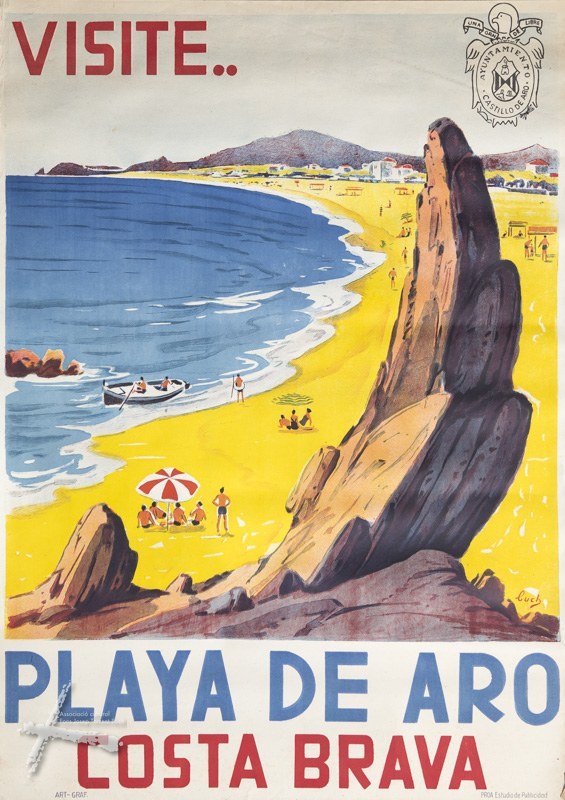
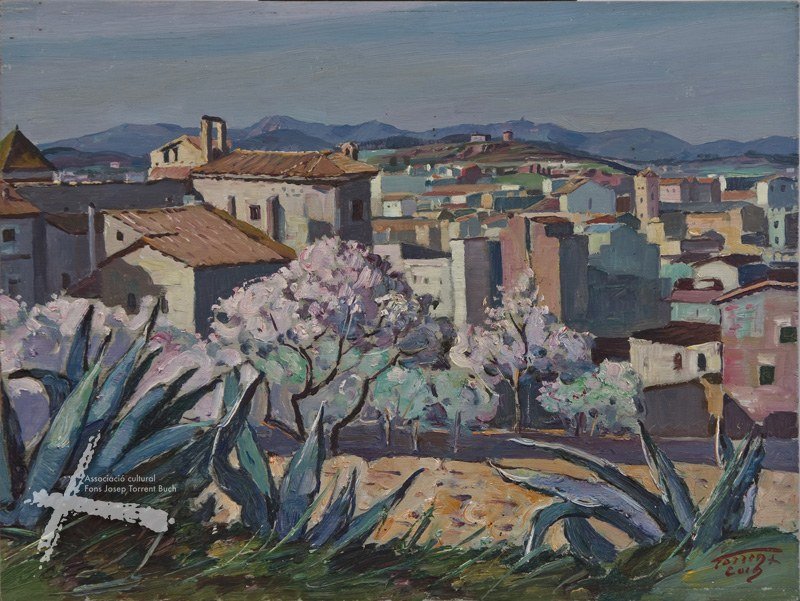
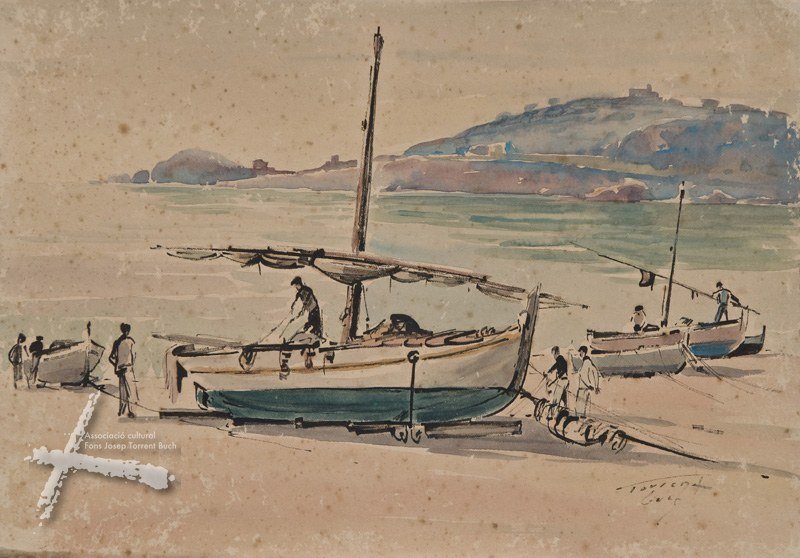
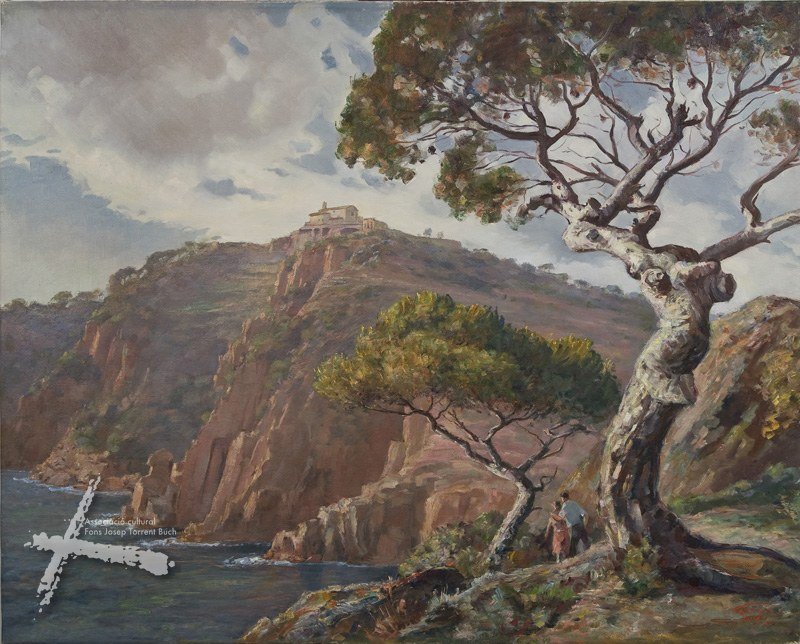
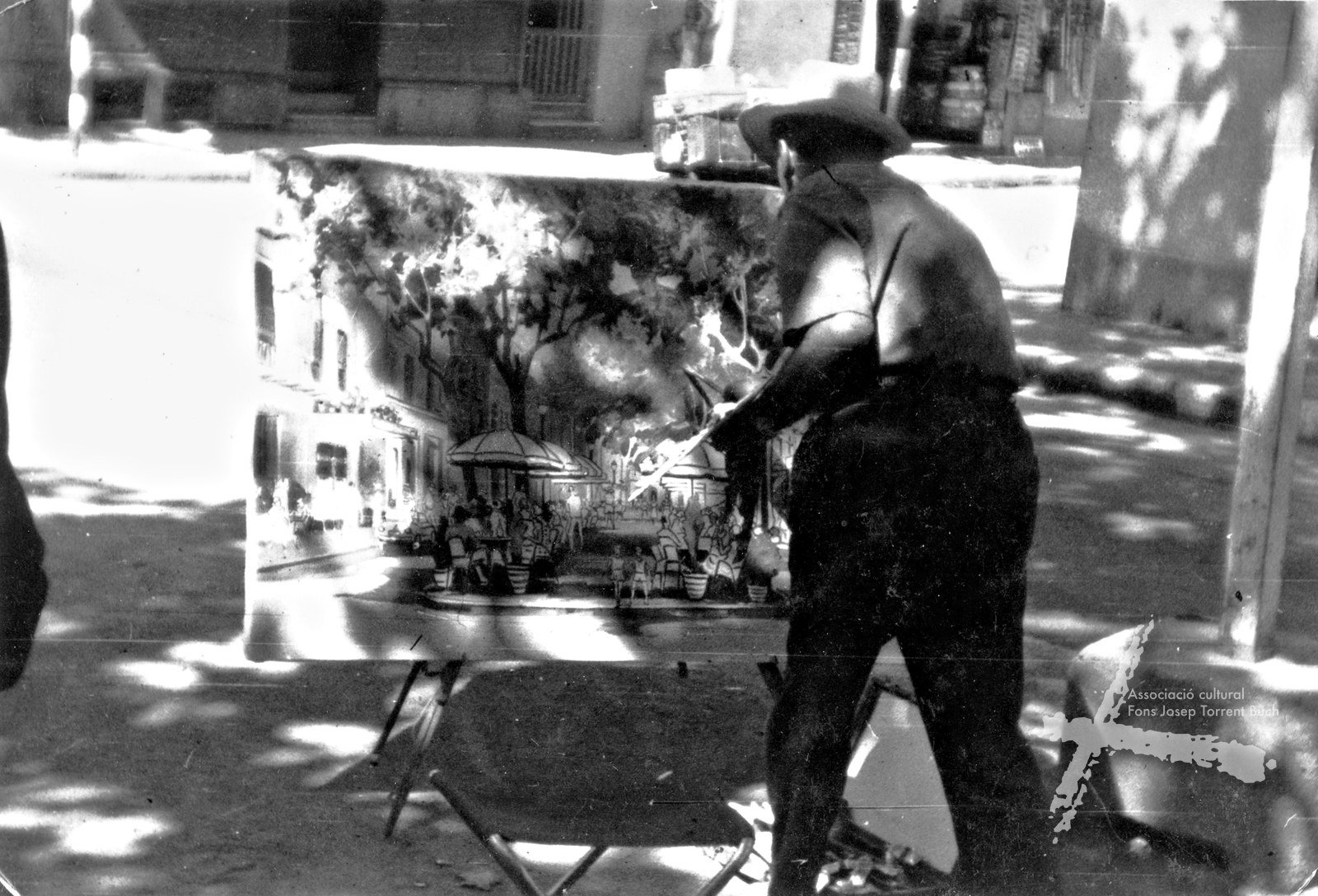
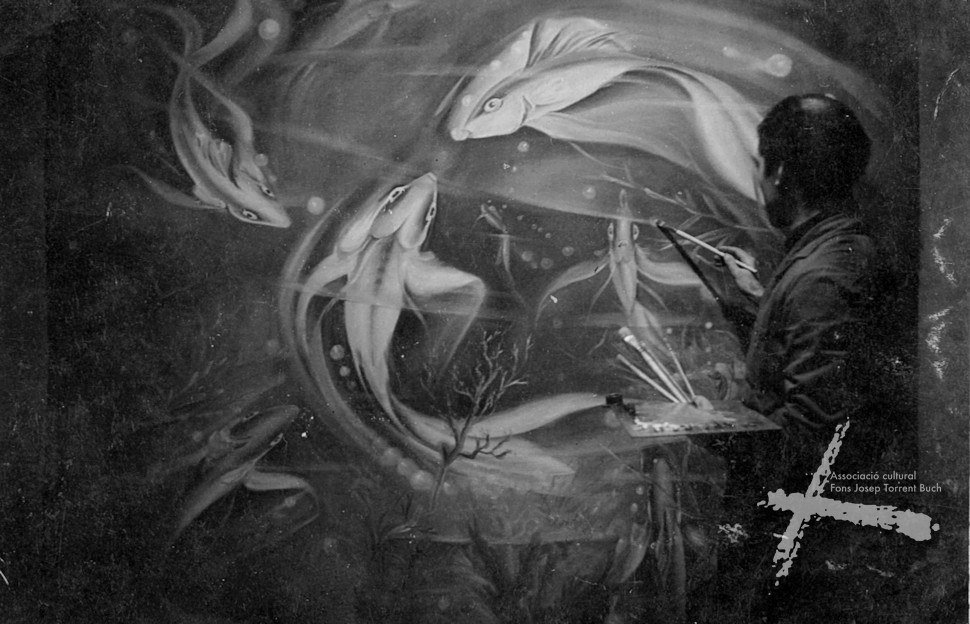
Tourist poster “Visite… Playa de Aro, Costa Brava”: yellow beach with rocks and a parasol Village landscape with almond trees in blossom and agaves in the foreground, oil signed in 1949 Watercolour of fishing boats beached on the shore, signed in 1947 Rocky cove with pines and a house on top of the cliff, oil Black-and-white photograph of Torrent Buch painting outdoors at an easel, in a street Black-and-white photograph of Torrent Buch painting a large underwater scene with fish
1960–1999

Consolidation as an Artist

It was his most productive period as a painter; he made the most of the great growth of tourism on the Costa Brava, opened his own gallery in Platja d’Aro, and created the first advertising poster of the Costa Brava and of Platja d’Aro, which at that time was growing enormously in tourist services.

He continued to exhibit in the city of Girona for more than forty consecutive years, as well as in Barcelona, Madrid and Sevilla; every summer he exhibited in Sant Feliu de Guíxols, Tossa, Lloret de Mar and Platja d’Aro. In fact, it is his territory, the Costa Brava. In winter he did so in the inland cities: Girona, Figueres, Barcelona, Rubí…

In 1962, in the midst of the December snowfall, he married Mercè Vilà Basart, and in May 1964 his son Carles was born.

They were years of a great deal of work; he could not stop producing work, and its sale was tremendous — in fact, he and his family lived from those sales throughout his life. Finally, it must be said that it was more than sixty years of painting and drawing under the most varied circumstances, but always without losing the sense of Art. It can be said without any doubt that it was a whole life devoted to painting, with more than 250 exhibitions and more than five thousand works created to his credit.

He held his last commercial exhibitions in 1984 in Girona and Sant Feliu de Guíxols. In 1994 he took part in a group exhibition of artists from Sant Feliu de Guíxols in Castellginest, in France.

In 1994, the Associació Turística de Sant Feliu de Guíxols awarded him the “Porta Ferrada d’Or” prize. This award has also been given to figures such as the President of the Generalitat Jordi Pujol and Baroness Thyssen, among others, in recognition of a life devoted to art and as an ambassador of the land where he was born.

In 1996 a Commemorative Exhibition was organised for him at the Centre Cultural Monestir de Sant Feliu de Guíxols, where he received various awards from the authorities.

He died in February 1999 in Sant Feliu de Guíxols, at the age of eighty-four.

His work forms part of private and institutional collections all over the world — more abroad than at home, since the first people to take an interest in his work were the first tourists who came to the Costa Brava.

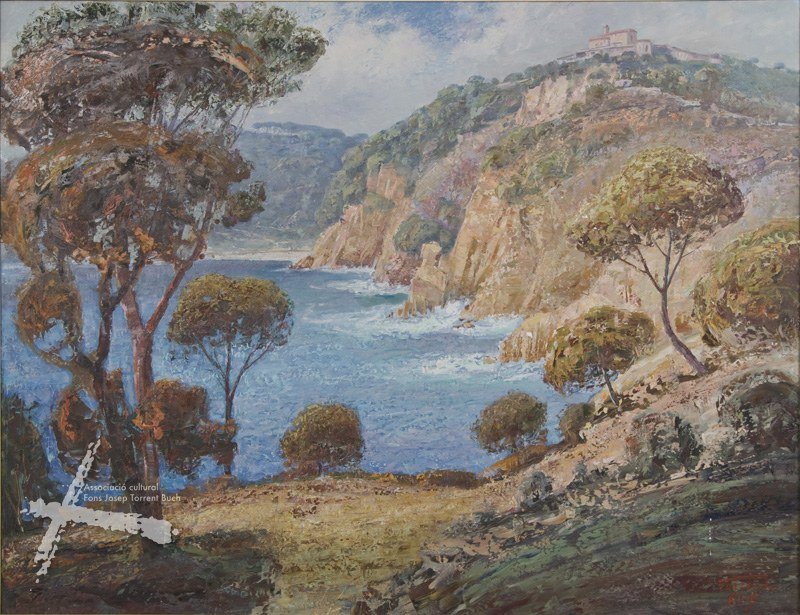
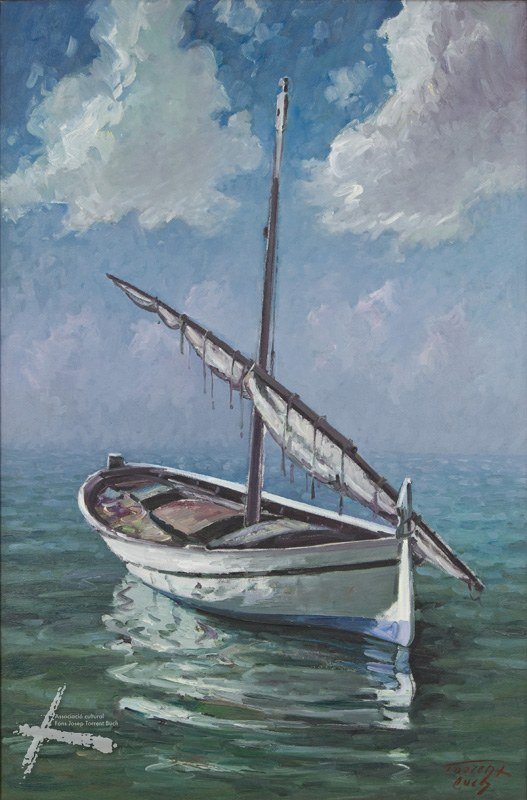
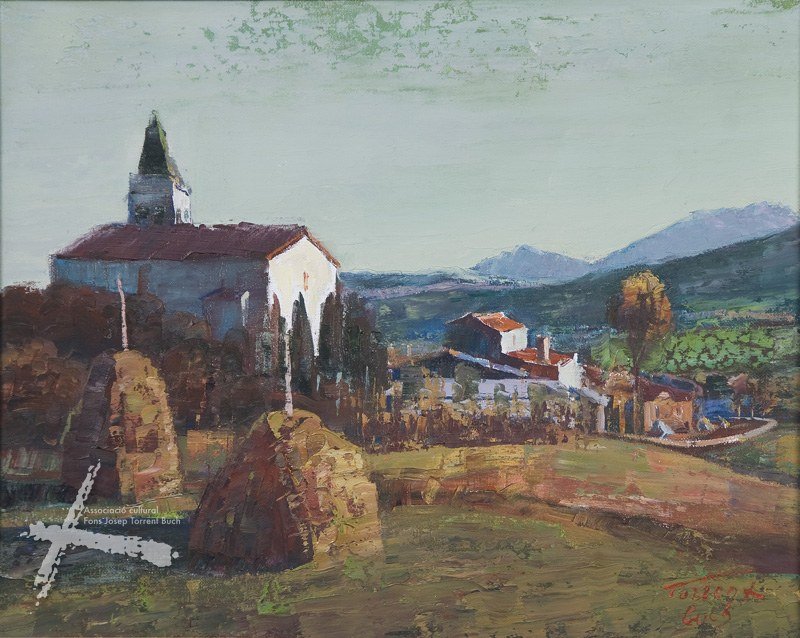
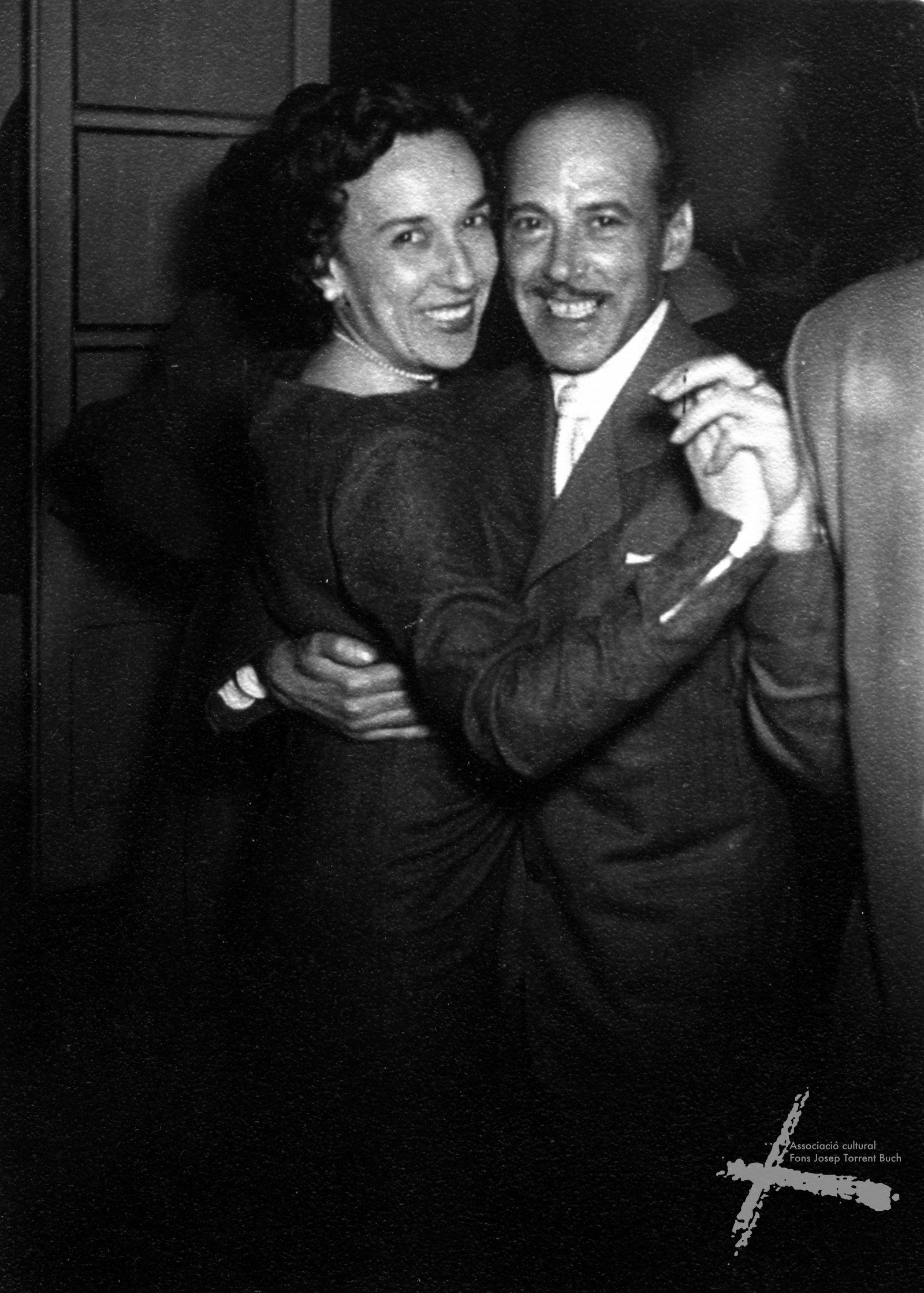
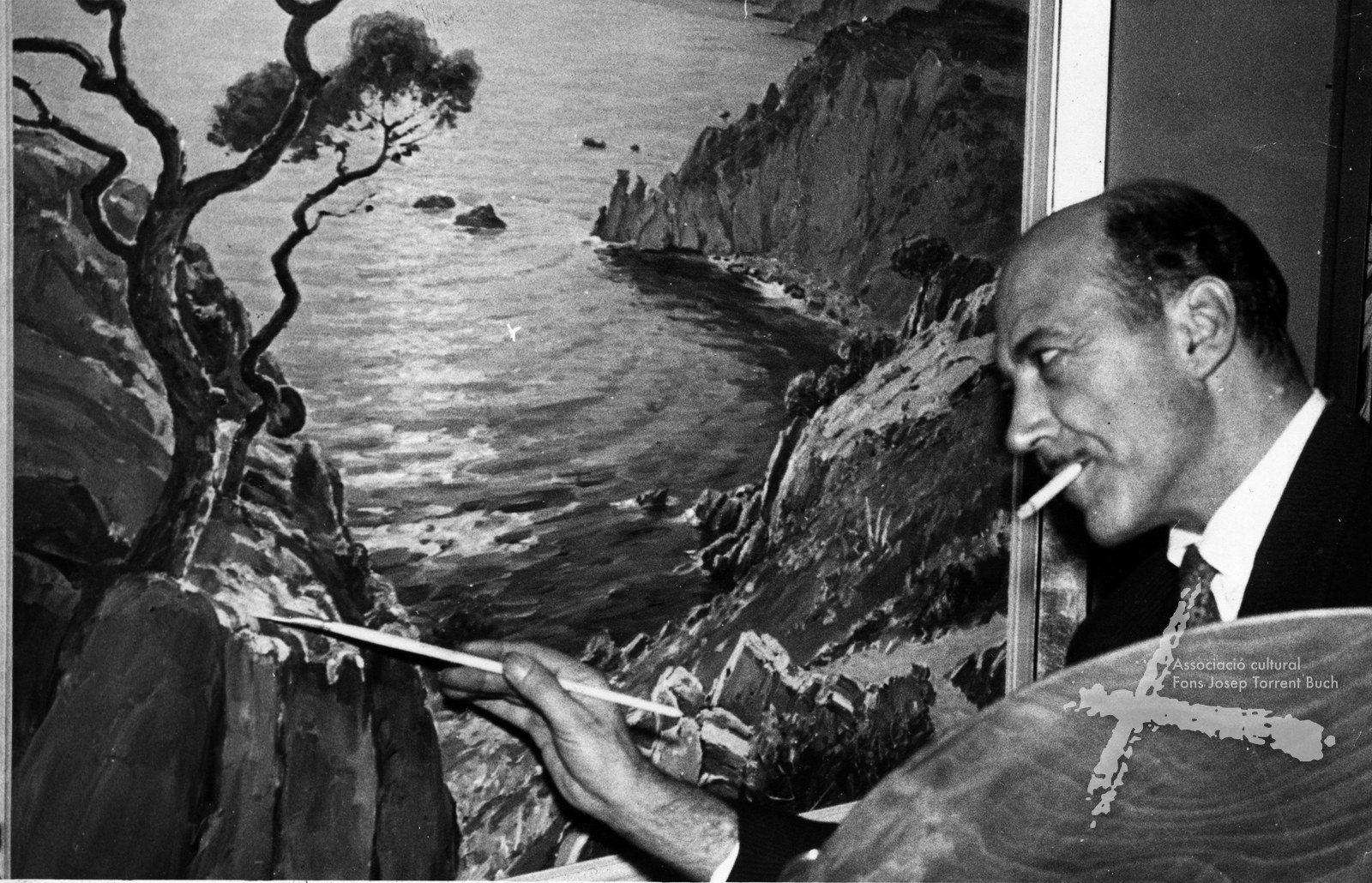
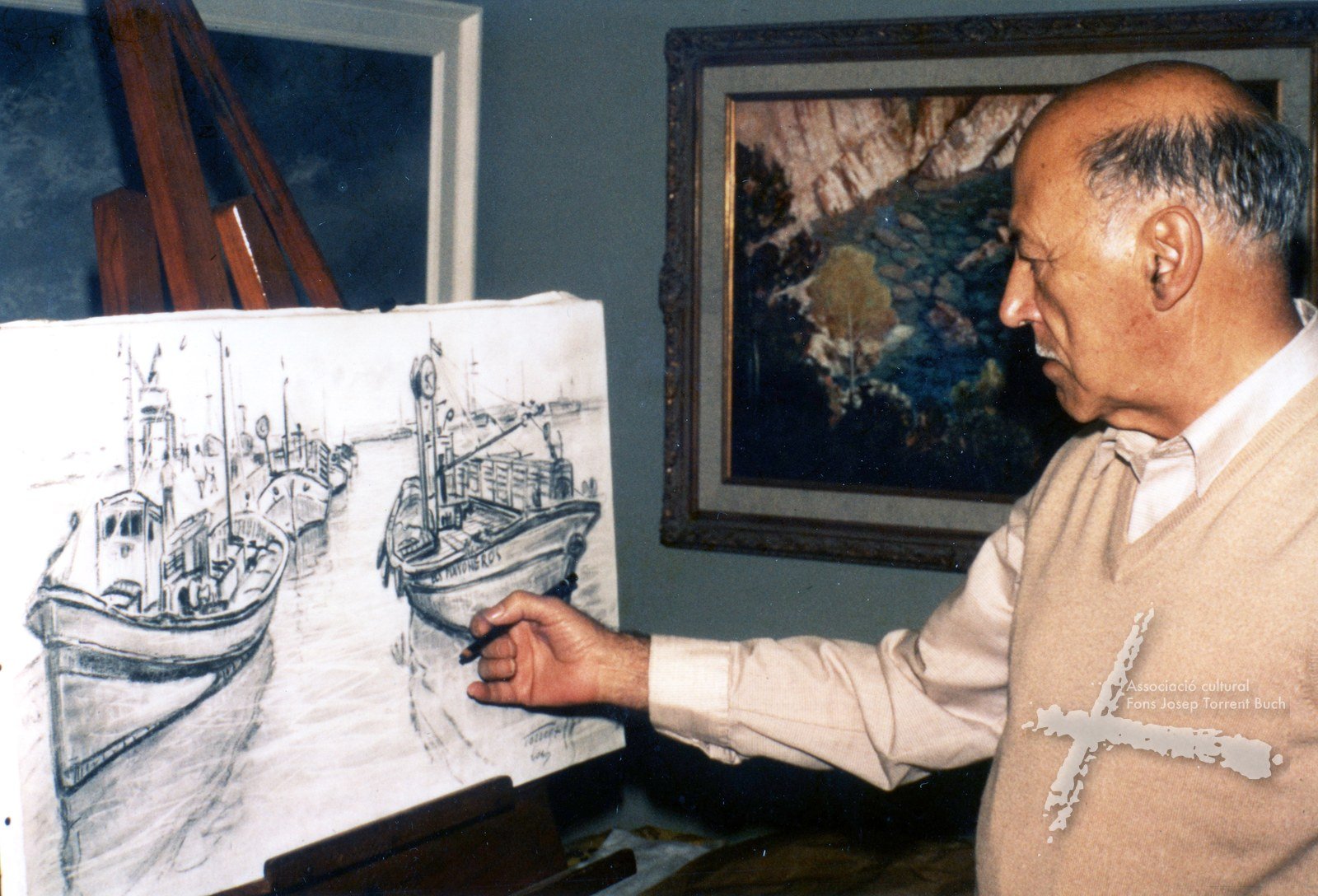
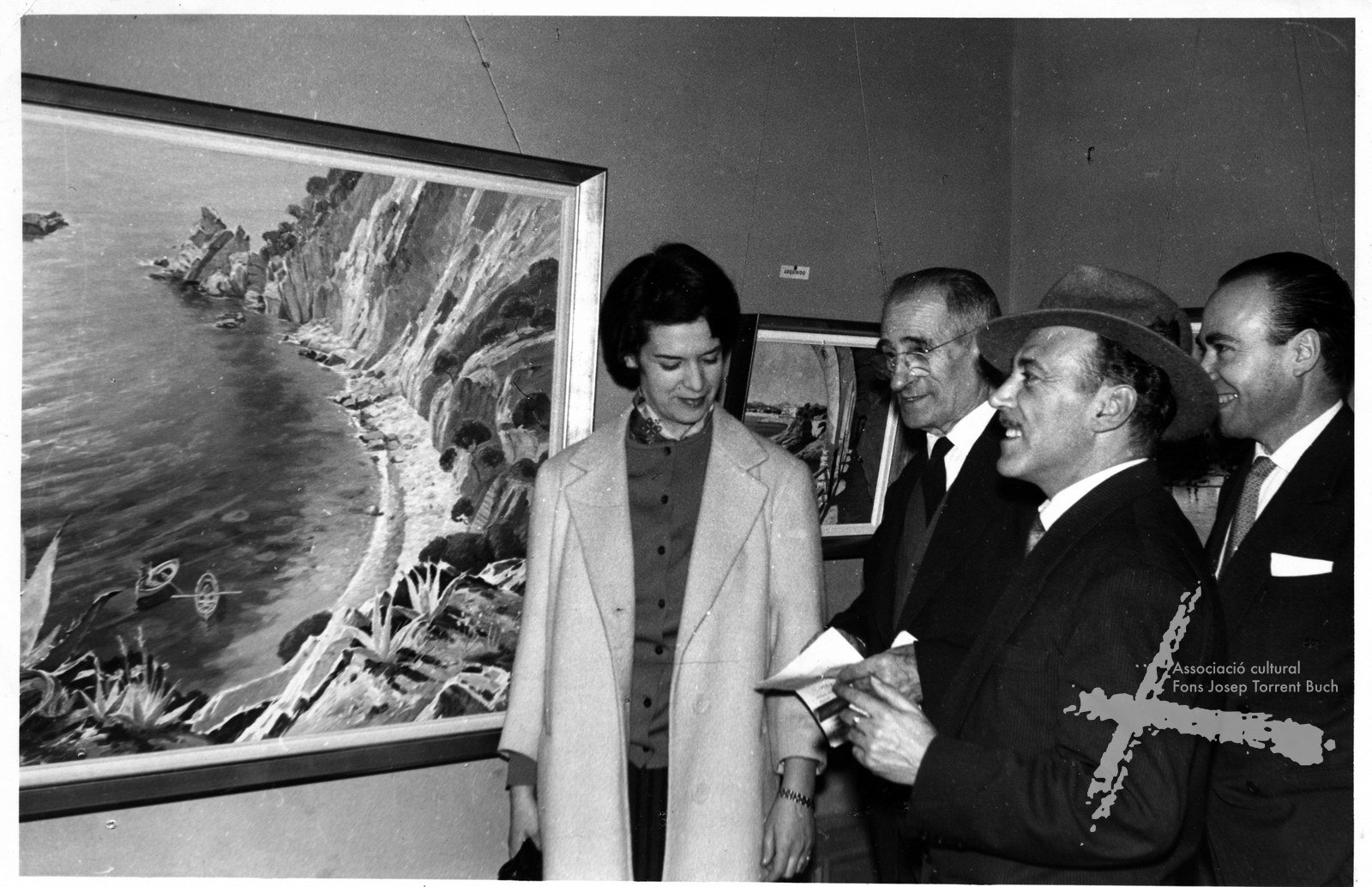
Coastal landscape with cliffs, pines and a house at the top, oil Lateen-sailed boat at sea, oil signed at lower right Church and village with haystacks, oil signed at lower right Rocky cove with turquoise water and agaves, oil Black-and-white photograph of Torrent Buch and Mercè dancing and laughing Black-and-white photograph of Torrent Buch painting a coastal landscape, smoking Colour photograph of Torrent Buch, now elderly, drawing fishing boats Black-and-white photograph of an exhibition: Torrent Buch, wearing a hat, talking with visitors in front of a coastal painting
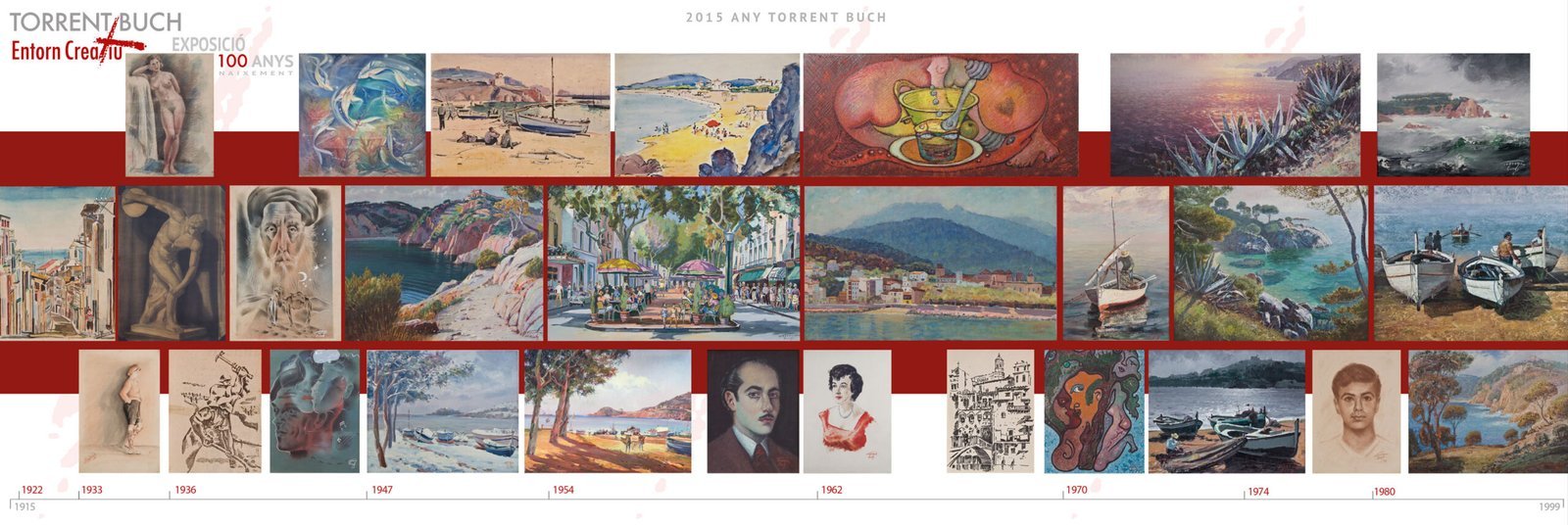
Diptych of the exhibition “2015, Any Torrent Buch”: chronological frieze of the artist's works from 1915 to 1999
Chronological frieze of the work, 1915–1999 · Exhibition of the centenary of his birth, “2015, Any Torrent Buch”

Work

The work, by fields

We present, by way of example, works from the artist's most distinctive periods; the styles and techniques are diverse, but even so they follow a pattern, determined both by the socio-economic conditions and by the Artist's own personal and professional growth.

Tap any work to see it enlarged; once open, you can move on to the other works in the same field using the viewer's arrows, the arrow keys or by swiping on the image. The images bear the Association's watermark, as in the Fons archive.

Technique

The artist's techniques

Torrent Buch used every technique within his reach. Choose a technique to see the works in the selection that use it.

Tap any work to see it enlarged and browse those in the same technique without closing the viewer.

The Fons catalogue

800 records, under review work by work

The heart of the new website will be the catalogue raisonné: each work with its record, its image and its unique reference. Right now the Association is thoroughly reviewing the 800 records in the database before publishing them.

Section under constructionThis section is under construction. The complete catalogue of the Fons will be published here once the review of the 800 records has been completed.

1

Database review

Manual verification of the 800 records: titles, techniques, dimensions, dates and locations, directly from the original databases of the archive.

2

Matching with the images

Each record is linked to the photograph of the work by means of its unique reference, so that no record is left without an image and no image without a record.

3

Publication of the catalogue

Search by title, technique, period and field, with a complete record for each work and — later on — the possibility of ordering prints in different sizes.

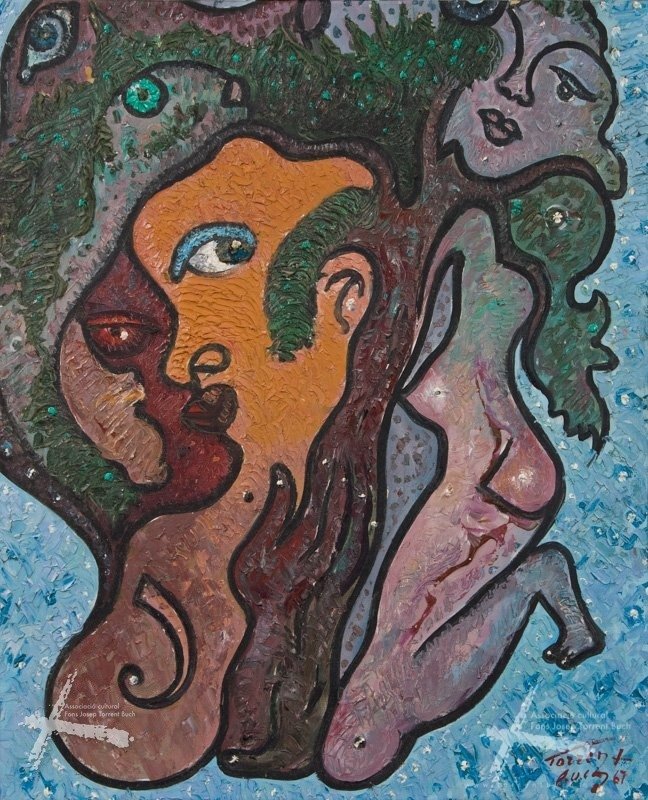
Surrealist work by Josep Torrent Buch signed in 1967, with intertwined faces on a blue background
Sample record · Fons ref.

Untitled

Technique
Oil on canvas, palette-knife technique
Year
1967 (signed and dated)
Field
Surrealism
Collection
Fons Josep Torrent Buch

This is how each record in the catalogue will look when it is published: image, reference, technique, dating and creative field.

Exhibitions

More than 250 exhibitions in sixty years

  • 1942

    He exhibits in Sant Feliu de Guíxols

  • 1943

    First exhibition in Girona.

  • 1944

    Sant Feliu de Guíxols, in August at the C.N.S. hall

  • 1944

    Municipal Hall, Girona.

  • 1945

    Municipal Hall, Sant Feliu de Guíxols

  • 1945

    Galeries Costa, Barcelona

  • 1945

    Municipal Hall, Girona.

  • 1946

    Sala Busquets, Barcelona

  • 1946

    Sala Fortunet, Figueres

  • 1946

    Sala Armengol, Olot

  • 1946

    Sant Feliu de Guíxols

  • 1947

    Municipal Hall, Girona

  • 1947

    Sala Busquets, Barcelona

  • 1947

    He receives a tribute at the painting school of Olot.

  • 1948

    Sala Busquets, Barcelona

  • 1948

    Municipal Hall, Sant Feliu de Guíxols

  • 1948

    Municipal Hall, Girona.

  • 1949

    Sala Busquets, Barcelona

  • 1949

    Municipal Hall, Girona

  • 1949

    Municipal Hall, Sant Feliu de Guíxols.

  • 1950

    He travels to the Balearic Islands to paint, and exhibits in Sóller and in Palma.

  • 1950

    He is named, by specialist critics, Painter of the Costa Brava.

  • 1951

    Municipal Hall, Girona.

  • 1951

    Municipal Hall, Sant Feliu de Guíxols, and other private venues.

  • 1955

    In summer he exhibits in Lloret de Mar, Tossa de Mar, Sant Feliu and Girona.

  • 1960

    He exhibits for the first time in Madrid, at the Sala Macarrón.

  • 1961

    Sala Macarrón, Madrid

  • 1961

    Sala Mateo, València.

  • 1962

    He exhibits in Lloret de Mar, Platja d’Aro and Sant Feliu, and in winter in Girona.

  • 1963

    In summer he exhibits in Lloret de Mar, Platja d’Aro and Sant Feliu, and in winter in Girona

  • 1964

    He exhibits at the Sala Ateneo, Sevilla

  • 1964

    Municipal Hall, Platja d’Aro

  • 1965

    He opens an art gallery in Platja d’Aro.

  • 1965-75

    He exhibits every year in Lloret de Mar, Tossa de Mar and Sant Feliu, in the summer months; in winter he exhibits in Girona.

  • 1970

    He takes part in a group exhibition with Josep Albertí and Josep Amat at the Reina Elisenda exhibition hall in Sant Feliu de Guíxols.

  • 1975

    L’Artística, Girona, and Mollet del Vallès.

  • 1978

    Galeria d’Art Rhodes, Figueres

  • 1978

    L’Artística, Girona.

  • 1979

    Retrospective, at L’Artística, Girona.

  • 1980-84

    Municipal Hall, Sant Feliu de Guíxols

  • 1980-84

    Municipal Hall, Girona.

  • 1982

    Galeria Art i Fang Mestral, Palafrugell

  • 1994

    He takes part in a group exhibition of artists from Sant Feliu de Guíxols in Castellginest, France.

  • 1994

    On 18 June he receives a tribute from the Associació Turística de Sant Feliu de Guíxols, which awards him the Porta Ferrada d’Or prize.

  • 1996

    Retrospective exhibition at the Centre Cultural Monestir de Sant Feliu de Guíxols.

  • 2015

    Any Torrent Buch · Centenary

    Retrospective exhibition for the centenary of his birth at the Monestir de Sant Feliu de Guíxols, with the chronological frieze of the work 1915–1999.

  • 2016

    Castell de Benedormiens

    Exhibition of the work of Torrent Buch at the Castell de Benedormiens in Castell-Platja d’Aro.

    Virtual tour with Google Street View ↗

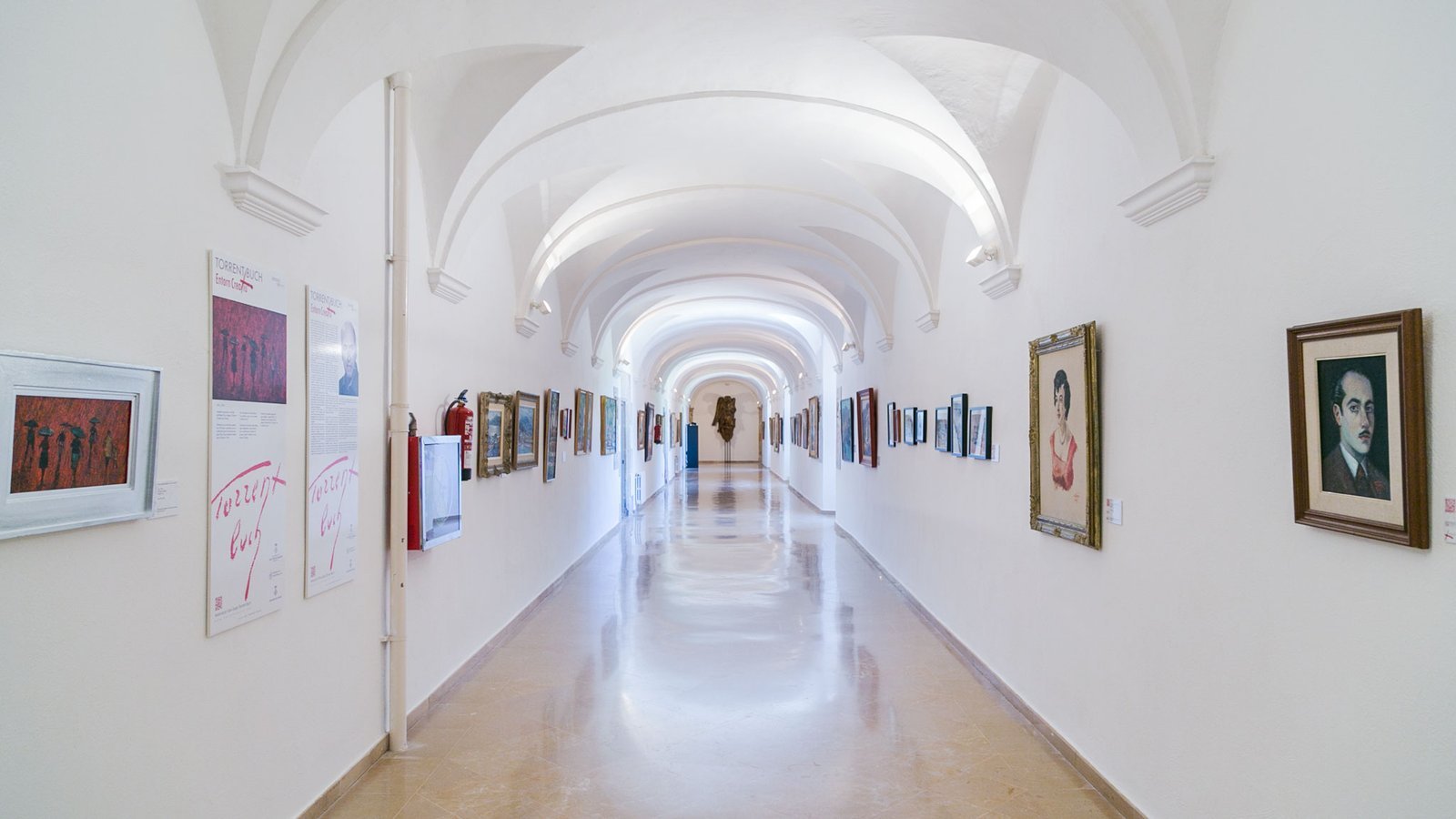
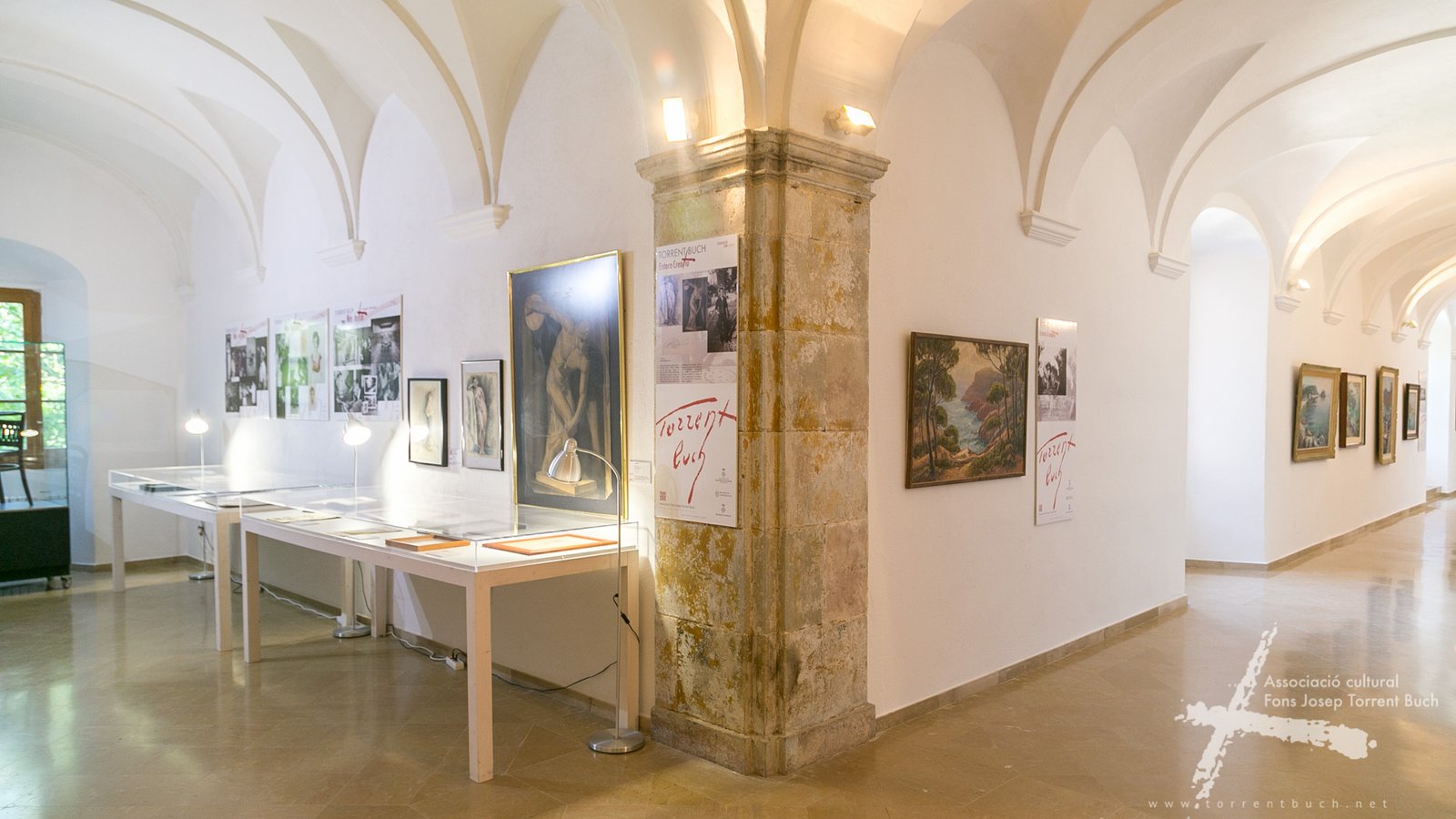
Vaulted corridor of the Torrent Buch exhibition with dozens of framed works
Vaulted exhibition hall of the Espai Monestir de Sant Feliu de Guíxols during the centenary exhibition, with works hanging and Torrent Buch posters
Exhibition “Torrent Buch, entorn creatiu” (2015), Espai Monestir de Sant Feliu de Guíxols

Press

The echo of a body of work

Black-and-white photographic portrait of Josep Torrent Buch in maturity

Josep Torrent Buch (1915–1999): the Painter of the Costa Brava

Josep Torrent Buch was born in Sant Feliu de Guíxols on 18 January 1915 and devoted more than sixty years of his life to painting. He is the artist whom critics dubbed, in 1950, “the Painter of the Costa Brava”.

He discovered drawing as a very young child — his first drawings date from between the ages of 7 and 10 — and trained at the Escola de Belles Arts in Sant Feliu, with Gertrudis Romaguera, and at the Barcelona School of Fine Arts, La Llotja (1933–1936), where he won three first prizes in drawing. The Civil War interrupted his career just as it was beginning: he served on the Aragon front, in the Cartography Service, and passed through the Agde camp, in France. Military service took him to Morocco, where he exhibited portraits and landscapes to great acclaim.

On his return to Sant Feliu, in 1942, he began the work that would make him unmistakable: the seascapes of the Costa Brava — Cala del Vigatà, Cala de l'Ametller, Sant Pol and the whole coast from Sant Feliu to Tossa — with the transparencies, lights and movements that define his style. He himself defined his painting as “a kind of impressionism expressing moments lived”. But his work goes far beyond seascapes: landscape, portraiture, still lifes, urban landscape, surrealism and a wide range of drawings.

Over the course of his life he held more than 250 exhibitions, in Barcelona, Girona, Madrid, Sevilla, València and abroad, and painted more than 5,000 works, now in private and institutional collections around the world. In 1994 the Associació Turística de Sant Feliu de Guíxols awarded him the Porta Ferrada d'Or prize, in recognition of a life devoted to art and as an ambassador of the land where he was born. In 2015, the centenary of his birth, the Monestir de Sant Feliu hosted the exhibition “Torrent Buch, entorn creatiu”.

The Associació cultural Fons Josep Torrent Buch preserves and promotes his legacy: this website is its gateway.

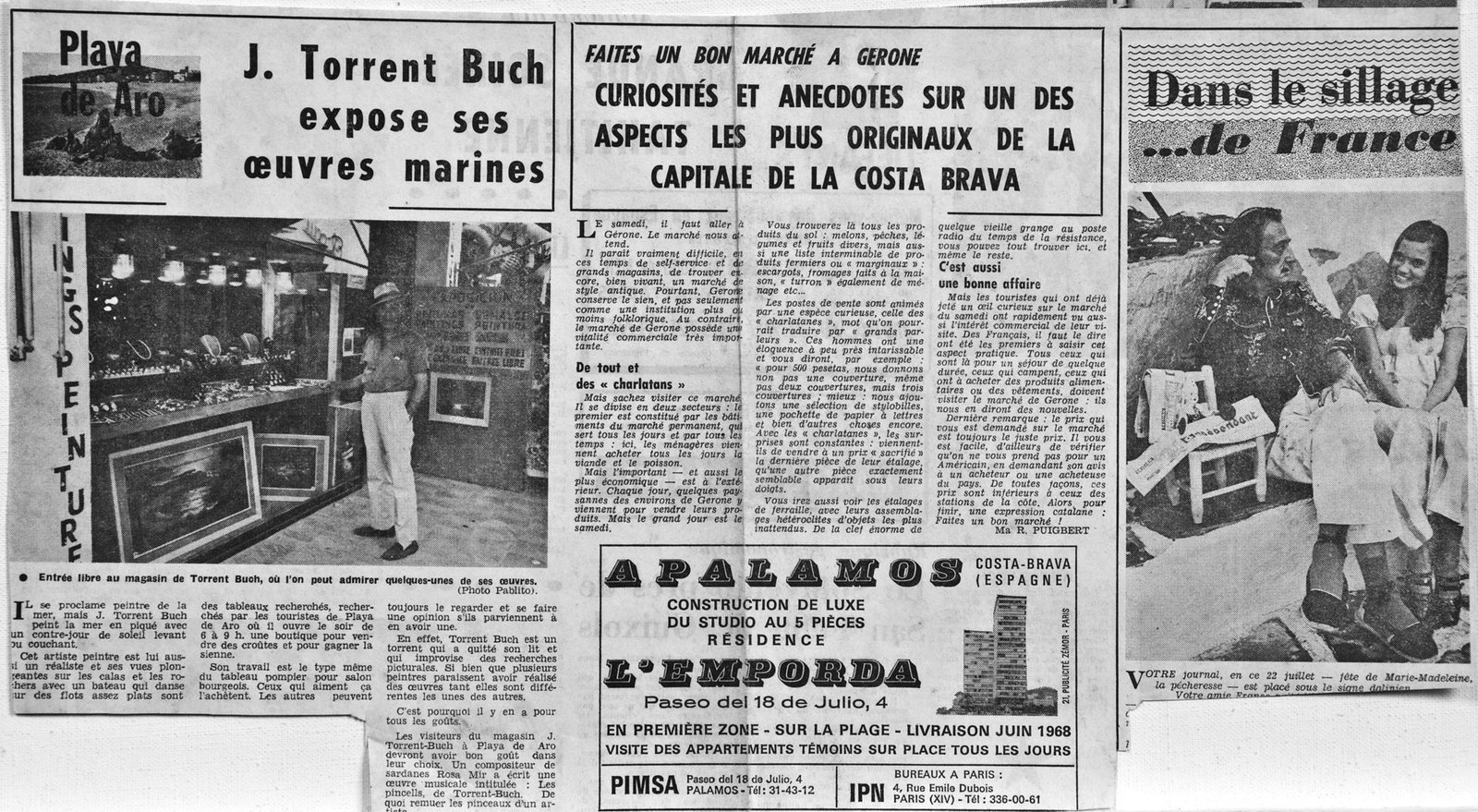
French press cutting from the 1960s: “J. Torrent Buch expose ses œuvres marines”, Platja d'Aro
French press, 1960s: “J. Torrent Buch expose ses œuvres marines” — his gallery in Platja d'Aro, a meeting point for the first tourists on the Costa Brava.

“The figure of a great artist like Torrent Buch well deserves to be remembered through his emblematic work, which led the art specialists of the time to call him the Painter of the Costa Brava.”

His career began in the 1930s, with his studies at La Llotja in Barcelona. After the war he created his most emblematic work: the landscapes of the Costa Brava, with seascapes of transparencies, lights and movements that defined a style of his own. Many of these works show us an unseen Costa Brava, practically unspoilt, that of the beginnings of tourism.

The Associació Turística de Sant Feliu de Guíxols awarded him the Porta Ferrada d'Or prize — also awarded to figures such as the President of the Generalitat and Baroness Thyssen — in recognition of a life devoted to art and as an ambassador of the land where he was born.

His works will reveal to many of us a singular and unrepeatable Costa Brava. Imma Gil Martí · Press release, 2015

Clippings from the archive

Interviews and reports of the period preserved in the Fons archive, bearing the Association's watermark. Tap a clipping to read it enlarged.

Los Sitios · 23 November 1974 «Torrent Buch, el pintor que más cuadros ha hecho de la Costa Brava» Interview by Gil Bonancia, with the sea as the ideal subject.
“5 Minutos” · No visible date «5 Minutos con Torrent Buch, el pintor de la Costa Brava» Interview by R. Albiol, conducted at the artist's exhibition at the Reina Elisenda hall.
Diari de Girona · Fets i Gent · 1994 «L'ATG dóna el IV Guardó Porta Ferrada d'or a l'artista guixolenc Torrent Buch» By Gemma Vila.
French newspaper · No visible date «Les peintres guixolencs: Torrent Buch, peintre de la nature» By Carlos Nadal.

News

News from the Association

New
Web 2026

New website!

We have reason to celebrate: after more than six years with the original website, the Association’s new website is now live at torrentbuch.net. We have renewed it to adapt it to current times, give it more visibility and make it responsive to the different viewing devices. Welcome to the new home of the Fons Josep Torrent Buch!

Current website ↗